Russell Tile repairs and rebuilds failed tile installations across the Sacramento area — leaking showers, failed waterproofing, drummy floors, and tile that has come apart because of how it was built. We find the underlying cause first, then rebuild the assembly properly instead of patching over it.
Properly installed tile lasts decades. When a shower leaks after five years or a floor starts coming apart, it is rarely the tile itself at fault — it is what sits behind and beneath it. Surface repairs leave that cause untouched, which is why the same problem tends to return.
We start by identifying what actually failed. Sometimes that is a shower pan that was never sloped to the drain. Sometimes it is a membrane that was punctured during construction, or tile set over a subfloor that flexes. Once we know, we can tell you plainly what it will take to fix it for good.
You get a straight answer about what failed and why, not a guess based on what's visible.
Hot mop pans and mortar float walls — the methods that hold up, not the ones that go fastest.
If a section can be saved, we'll say so. If it can't, we won't sell you a repair that will fail again.
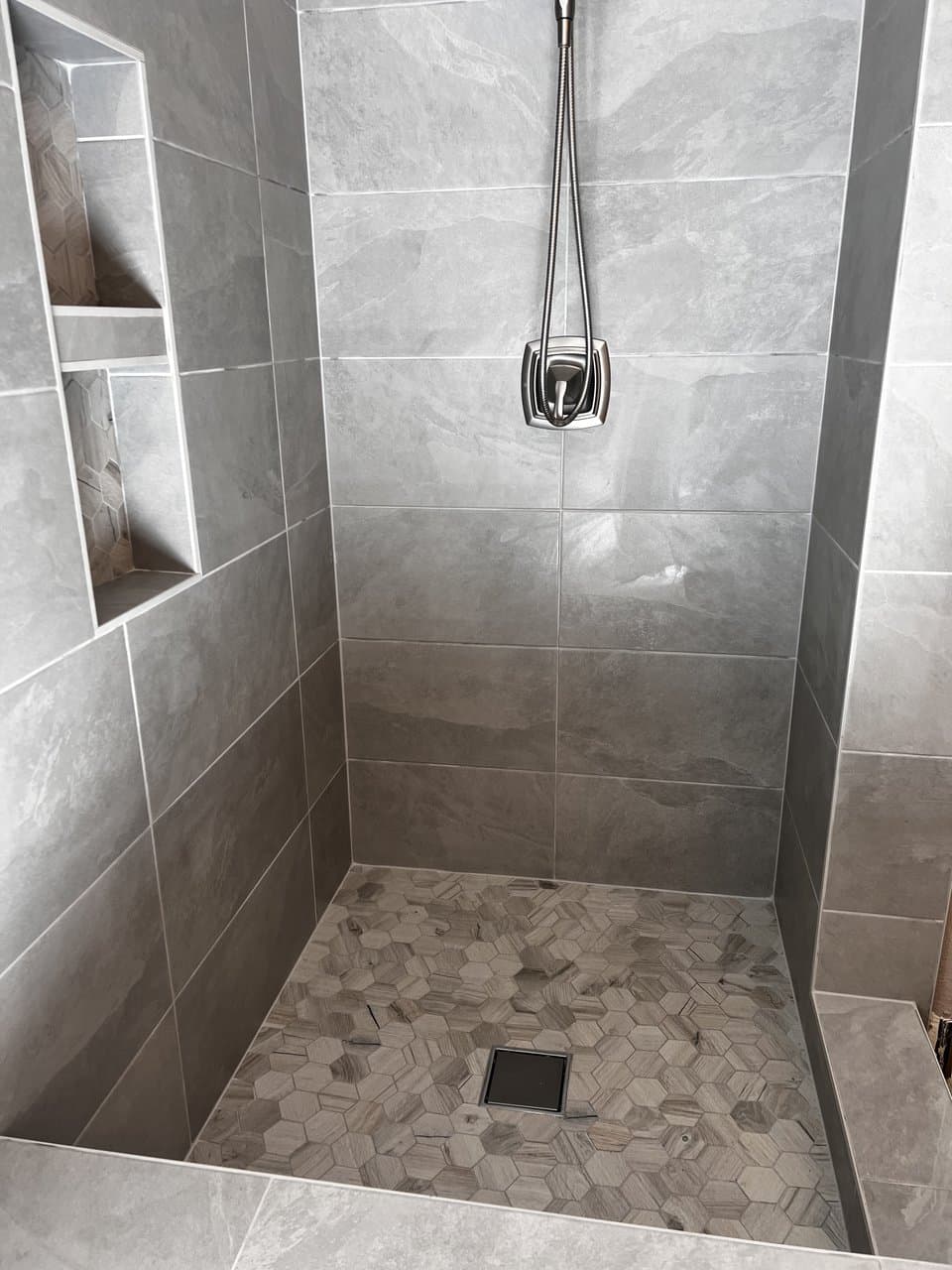
Our repair work centers on tile and shower assemblies that have failed structurally — the problems that need rebuilding, not resurfacing.
Water showing up on the ceiling below, in an adjacent room, or along the base of the shower. By the time it's visible, the waterproofing behind the tile has usually already failed.
Pans that were never sloped correctly, missing or punctured membranes, and curbs built without a continuous waterproof layer. This is the most common reason a shower fails early.
Tile set over flexing subfloor, unsuitable backer board, or a slab with unaddressed movement. The tile is the symptom — the layer underneath is what actually failed.
Hollow-sounding floors, cracking that follows a line across the room, or tile lifting across a whole section. Widespread failure points to an installation problem, not isolated damage.
Full tear-out and rebuild of a failed shower — new pan, new waterproofing, new tile. Built the way it should have been the first time, with a hot mop pan and mortar float walls.
Once a shower or floor is opened up, it's often the right moment to change the layout, the tile, or the whole room. We can take the work straight through into a full renovation.
A quick read on what your tile is telling you before we ever look at it.
Water stains on the ceiling below a bathroom
The shower pan or waterproofing membrane has failed — not the tile
Tiles that sound hollow or drummy underfoot
The tile never bonded properly, or the substrate is moving
Cracks running in a straight line across a floor
Movement in the slab or subfloor telegraphing through the tile
Grout that keeps cracking out no matter how often it's replaced
Deflection underneath — regrouting will keep failing until it's addressed
A musty smell or soft spot near the shower base
Water has been getting behind the assembly, likely for some time
Loose or missing tile spreading outward over time
A bonding or substrate failure that will continue until it's rebuilt
We would rather be straight with you up front than take on work we're not the right shop for.
These are real trades — they're just not ours. We build and rebuild tile assemblies, and we'd rather point you elsewhere than do a version of the work we wouldn't stand behind.
The same sequence every time, because skipping any of it is how showers end up failing in the first place.
We determine what failed and how far the damage extends. That means looking past the tile at the pan, the membrane, and the substrate underneath.
Failed material comes out entirely — tile, backer, and the old waterproofing. We don't build new work on top of a compromised assembly.
Any damaged framing, subfloor, or backing is repaired and made flat and solid before a waterproofing layer goes anywhere near it.
A hot mop pan and mortar float walls. It takes longer than a foam kit, and it is the reason our showers don't come back to us.
Tile is set into a proper bed, with layout planned so cuts land where they should. Grout and sealing finish the assembly.
More on the systems we use in shower waterproofing, or see our bathroom remodeling and shower installation work.
Tile and grout are not waterproof — the membrane and pan behind them are. When a shower leaks, it is almost always because that hidden waterproofing layer has failed, not because of anything visible on the surface. The tile can look perfect while water moves freely behind it.
That is not the work we focus on. In our experience, tile that cracks or comes loose is usually reporting a problem underneath it, and swapping individual tiles leaves that cause in place. We concentrate on diagnosing the failure and rebuilding the assembly properly.
Widespread symptoms are the tell. Isolated impact damage stays isolated. Hollow sounds across a room, cracking that follows a line, grout that keeps failing after repair, or a shower that leaks within a few years generally point to how the assembly was built rather than how it has been used.
Often yes. If the substrate is flexing or the tile never bonded correctly, the failure tends to keep spreading outward into sound areas. Replacing the failed section alone usually means doing the work twice. We will tell you honestly which situation you are in.
A hollow or drummy sound means the tile is not fully bonded to what is beneath it. It may be an incomplete mortar bed, the wrong setting material, or a substrate that has moved. Those tiles will usually crack or lift eventually, so it is worth investigating early.
Frequently, and it is often the sensible moment for it. Once a failed shower is opened up, the demolition and waterproofing work is already underway, so changing the layout, fixtures, or tile costs far less than starting a separate project later.
We assess and rebuild failed tile and shower installations across the region.
Tell us what you're seeing and we'll tell you what it likely means. If it needs rebuilding, we'll show you exactly what that involves.
Financing available through Hearth. Learn more
Russell Tile has partnered with Hearth to offer affordable financing for your tile project.